EDEsa DataMade with PageDuo.aiPageDuo.aiMake your own for freeCreate for free

Architecture / interactive map

Find the boundary before you debug the symptom.

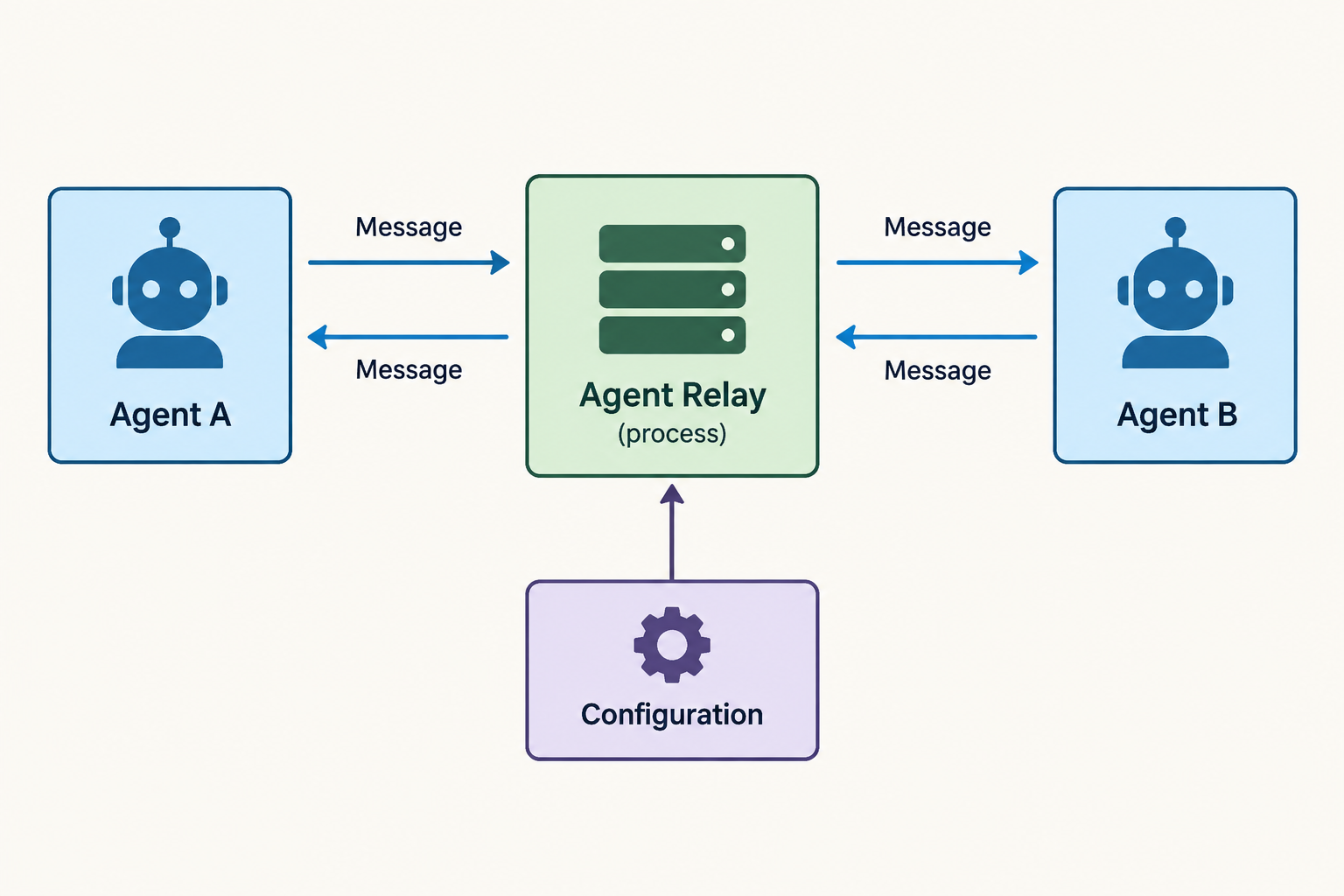
Agent Relay is easiest to reason about as a path: one agent sends, a relay process handles the crossing, and another agent receives. Select a component or path to inspect its responsibility, evidence status, and safe next question.

01 / System map

One crossing, five ownership questions

Use the visual map for orientation, then select a node or path to inspect the responsibility that can be stated safely from the supplied repository material.

Select a component or message path

The arrows describe direction, not a claimed wire protocol. The source material identifies a FastAPI communication intermediary and database-backed task flow; exact interfaces and fields must still be verified in repository code.

02 / Responsibility map

Keep the layers separate

When diagnosing a relay, first identify which layer owns the evidence. A payload problem is not automatically a transport problem.

Transport

Owns the communication channel between an agent and the relay boundary. Observe whether a connection can be established and whether bytes or messages can cross it. No specific transport, port, or endpoint is asserted here without repository evidence.
Routing

Owns the relay’s decision to accept an incoming message and direct it toward the intended recipient. This is the right layer when ingress is visible but delivery does not occur.

Application payload

Owns the meaning carried by the message: the application’s request, response, or error content. The architecture page does not claim field names or a schema because none was supplied for verification.

Boundary heuristic: if the sender cannot establish communication, start at transport; if the relay sees ingress but the recipient sees nothing, inspect routing; if the recipient receives data but behaves incorrectly, inspect the application payload.

03 / Message lifecycle

Trace one message without guessing its schema

This trace is intentionally event-shaped rather than protocol-shaped. It gives you an observation order while avoiding invented event names or fields.

  1. Agent sendThe sender constructs an application-level message and attempts to hand it to the relay boundary.
  2. Relay ingressThe relay process receives the incoming communication. This is the first place to compare sender-side evidence with relay-side evidence.
  3. Relay handlingThe process applies its routing responsibility. The exact implementation mechanism and message fields must be confirmed in the repository source.
  4. Recipient deliveryThe relay forwards the message toward the recipient agent, where delivery and application handling can be observed separately.
  5. Response or errorAn outcome may travel back through the same conceptual boundary. Its exact shape is repository-defined, not assumed by this diagram.

What crosses the boundary?

At minimum, the boundary carries communication from one agent context to another through the relay process. Treat the payload as opaque until the repository identifies its schema.

Agent → relayConnection attempt and application message ingress.
Relay internalAcceptance, routing decision, and handling.
Relay → agentForwarded delivery and any resulting response path.

04 / Process boundary

Configuration is an input, not a contract you should invent

Configuration belongs beside the relay process because it controls how the local runtime is started or connected. Copy only verified values from the repository’s own instructions.

Safe integration workflow

Start with the repository’s documented quick-start path. Record the command, environment assumptions, and connection values exactly as documented. Then identify which side owns each value: sender, relay process, or recipient.

Keep secrets and machine-specific values out of committed examples. This page intentionally provides no fabricated configuration keys, ports, URLs, or environment variables.

# Verify these values in the repository before integrating:
# 1. How the relay process is started
# 2. How an agent connects to it
# 3. Which message shape the source actually accepts
# 4. Which logs or errors identify ingress and delivery

05 / Failure paths

Debug from the first missing observation

Do not jump directly to the recipient. Compare the same message across each boundary and stop at the first place its evidence disappears.

No connection

Start at the sender-to-relay boundary. Verify the documented startup and connection instructions, then inspect the relay process’s own output. Do not infer a port or endpoint from the diagram.

Ingress, no delivery

If relay-side ingress is observable but the recipient receives nothing, focus on relay handling and routing. Compare recipient identity or destination information only against fields the source actually defines.

Delivery, wrong outcome

If the recipient receives the message, move above the transport layer. Inspect application payload interpretation and response handling rather than changing connection settings.

06 / Source-backed notes

A diagram is a guide to the code, not a replacement for it

The supplied project context establishes Agent Relay as an open-source repository and describes agents claiming tasks through a database-backed HTTP API, with FastAPI as the communication intermediary. It does not include complete file contents, protocol definitions, configuration keys, or message schemas. Those details remain deliberately unclaimed here.

How to validate this map locally

Follow the project’s documented run instructions, locate the relay process entry point, and trace the code path from agent send through relay handling to recipient delivery. Update your operational notes with the actual module names and fields you find.

Provenance: the database-backed HTTP API and FastAPI intermediary are repository-backed claims from the supplied homework material. The component boundaries and debugging advice on this page are conceptual guidance unless a source path is named.

A labelled system diagram showing a sender agent, a central Agent Relay process, a recipient agent, configuration, and bidirectional message arrows
Resolved architecture fallback image. The interactive map above remains the primary accessible control surface.