EDEsa DataMade with PageDuo.aiPageDuo.aiMake your own for freeCreate for free

Open-source developer reference / overview

Agents need a boundary. Relay it.

Repository evidence

Agent Relay is a repository for connecting agents through an explicit communication boundary—so the path from sender to recipient can be understood, run locally, and integrated with care.

Evidence legend: Repository evidence marks claims directly supported by supplied repository material. Unverified guidance marks details not confirmed from source; check the repository README and source before relying on them.
Repository evidence source https://github.com/ketut-garjita/agent-relay
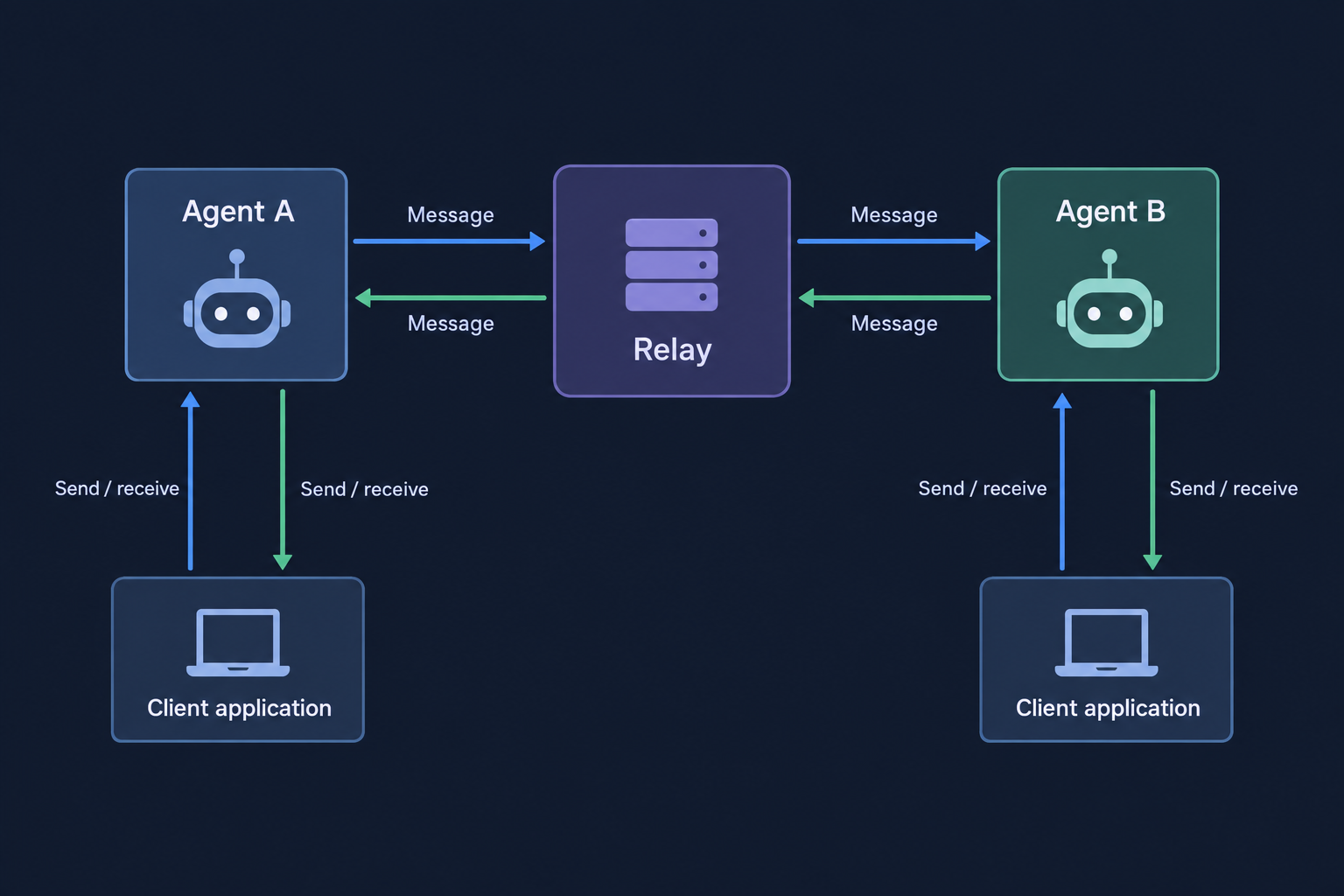
A clean wide technical illustration of multiple software agents exchanging messages through a central relay service, with generic labels Agent A, Agent B, Relay
Unverified guidance
The useful mental model: sender agent → relay → recipient agent. Check the repository architecture and source to confirm how this model maps to the implementation.

01 / message path

See the boundary before reading the details.

Unverified guidance
This preview keeps the concept deliberately small. It does not imply endpoint names or message fields; it shows a communication relationship to verify against the repository's README and source.

Agent Asender
Relayboundary
Agent Brecipient

02 / orientation

What Agent Relay is useful for

Unverified guidance

Think of the relay as the place where communication between independent agents gets an observable boundary. Instead of treating every agent-to-agent connection as a private implementation detail, a relay gives the system a location to understand and integrate around. Confirm this stated purpose in the repository README and source.

Unverified guidance

The repository—not this overview—is the authority for concrete runtime behavior. When you move from concept to implementation, use its README and source to verify the actual commands, interfaces, message fields, and configuration.

Grounding rule

Unverified guidance
Technical reference is only useful when names are exact. This site keeps conceptual language broad here and sends protocol-level questions to the repository-backed reference pages. Check the repository README and source for the exact terms.

03 / engineering rationale

Why put a relay in the middle?

01
Unverified guidance

Routing becomes a visible concern

A central boundary makes the sender-to-recipient path easier to reason about than a collection of implicit peer connections. The important question becomes “what crosses the relay?” rather than “which agent knows about every other agent?” Confirm this rationale and any routing behavior in the repository source.

02
Unverified guidance

Agents can stay separated

Each agent can focus on its own role while the communication boundary provides a place to connect them. The separation is architectural, not a promise about a specific protocol or deployment mode. Check the repository architecture and implementation before treating this as a project fact.

03
Unverified guidance

Local inspection gets easier

Running the repository locally gives developers a concrete surface to inspect: source, configuration, requests, and the behavior documented by the project itself. Start with the repository instructions before adapting the integration; confirm the supported local workflow in the README and source.
04 / documentation map

Four jobs, four destinations.

Unverified guidance
This site is organized as an executable reference rather than a product tour. Confirm the available guides and their scope in the linked pages and repository source.

Run Unverified guidance

Quick Start

Where do I get the repository, run it locally, and verify the project-specific instructions? Check the repository README and source for the actual setup.

Open setup guide →
Reason Unverified guidance

Architecture

How should I think about agents, the relay boundary, message movement, and integration seams? Check the repository architecture and source for the implemented model.

Read the system view →
Integrate Unverified guidance

API Reference

Where can I verify the repository's real endpoints, messages, and configuration keys? Check the repository source; this overview does not confirm them.

Open the reference →
Check Unverified guidance

Exam

Can I explain the relay flow and distinguish grounded repository facts from assumptions? Check the repository material before treating any answer as confirmed.

Take the self-check →

05 / first local step

Begin with a verified checkout.

Unverified guidance
The clone command is intentionally limited to the public source URL. Use the repository's own README for the runtime, dependency, and configuration commands that follow; confirm those details in the repository before running them.

Repository evidence
git clone https://github.com/ketut-garjita/agent-relay
cd agent-relay

06 / provenance

The source stays in view.

Unverified guidance
Agent Relay is evaluated here as an open-source repository, not as a generic “agent platform.” The source URL is the anchor for every implementation claim. If a term is not verified in the repository, it is presented as a concept to investigate—not as an API fact. Check the repository README and source for confirmation.

Canonical source

Repository evidence
github.com/ketut-garjita/agent-relay

Unverified guidance
Next: use the setup guide, then compare the architecture model with the repository's actual implementation.